Contact the Author by eMail

Artist Photographer, Graphic Designer, and researcher focused on the history of taxidermy and natural history collections, with a special interest in 19th century culture.

Please note: Annick @Aldoworkshop is not affiliated with the Royal Museum for Central Africa, rather a natural history enthusiast dedicatedly passionate about the museum and its mission.

Copyright - ALDoWorkshop

Annick Aldo © 2011 - 2016

PHOTOS @ ALDoWorkshop

All rights reserved. No part of this site may be reproduced or transmitted by any means without the prior permission in writing of the artist. All images are the work of AldoWorkshop and are subject to copyright.
It is Museum Menagerie's policy to respect the copyright and intellectual property rights of others. Historical images published on this blog are made available for private study, considered to be in public domain or under an open license; the source information is provided in the post's reference list.


Contact the Author on Blogger

Name

Email *

Message *

Showing posts with label RMCA. Show all posts

Northern White Rhinoceros

Rhino horns, which are prized by Chinese medicine, have been removed from the mounted specimens on display at the Royal Museum for Central Africa over fears they would be stolen amid a spree of museum robberies across Europe.
The Northern white rhino, a genetically distinct subspecies from the Southern white rhino, was once quite abundant throughout North-Central Equatorial Africa. As of 2011, they are considered as probably extinct in the wild. (IUCN)

‘Rhinoceros simum cottoni’

Its very existence was not known until Captain A.St.H. Gibbons brought back a white rhino skull and horns form Lado district, and exhibited in America in 1900. But it was Major Powell-Cotton’s discovery which caused quite a sensation in scientific circles.
In 1908, he presented a skull and horns of a Lado white rhinoceros to the British Museum enabling the curator in London, Mr. Lydekker to establish a new subspecies, which he named ‘Ceratotherium simum cottoni’ in honour of Powell-Cotton.
Since that time, several sportsmen have subsequently brought to Europe specimens of this northern race. Powell-Cotton collected a series of complete skins and skeletons on an expedition into the Lado enclave in 1904-1907. One of these, now a taxidermied rhinoceros in the Royal Museum for Central Africa, was mounted by Rowland Ward. Another gigantic bull, shot by Armand Solvay during safari in the Lado enclave, was donated to the Tervuren Museum and also mounted by Ward.
White Rhino of Lado, collected by Solvay, c.1909. (Photo : J. Desneux)
White Rhinoceros of Lado, collected by Solvay.
White Rhinoceros of Lado, collected by Powell-Cotton.

In Unknown Africa

Powell-Cotton, who had spent more than 26 years exploring the most remote and unknown parts of Africa, had had a good many opportunities of observing the game. Aware that species were in danger of “vanishing”, he believed protecting game from wasteful and unethical hunters was a wise and necessary precaution crucial to the survival of wildlife.
Although an avid hunter himself, Powell-Cotton selectively hunted in order to collect natural history specimens that he thought would be useful to science. While we have rather different ideas of how conservation issues are perceived and tackled today, the Major’s exceptionally careful and detailed field notes helped advance our scientific understanding of the wildlife of Africa and provide an invaluable historic record for environmentalists and conservationists of today who are seeking to protect endangered species.
In his book, entitled ‘In Unknown Africa’, Powell-Cotton had predicted that some species were doomed to disappear due to man's exploits and ignorance :
“One day when it’s too late, it will be found that a species belonging to some spatial district has been extinguished, and it will then be realised that the only specimens extant are in some museum on the Continent”.

White Rhinoceros of Lado

Armand Solvay and his bull rhino at Lado 1907.
Although the Lado Enclave was a small, remote area in central Africa, it was well known for its enormous herds of elephants which drew big-game hunters from around the world between 1904 and 1912.
Armand Solvay travelled to Lado for hunting, and shot a very exceptional male white rhinoceros, with the horn measuring 0m98. Here is his account of the day:
6th March 1907 - “At 7 am I come upon a trail of two rhinos leading away from the watering hole. Instantly I follow up the tracks and at 11 o'clock I arrive at the spot where they are taking their noonday rest, seeing them both at about five hundred meters. I advance up to a hundred meters as a nearer approach could not be made for lack of cover. I fired three to four shots at one of them, but upon following the trail of the beasts, I spot another rhino at three or four hundred meters away, coming out from behind a bush; it is much bigger than the first two. It continues its very slow trot over a plain scattered with trees on average four or five per hectare; and also a few bushy stems. As soon as I saw the brute, I went after it; I advanced with precaution to a small tree a hundred meters from the it ; whilst wondering how I was going to approach closer I heard a noise on my right; I turned and saw two rhinos advancing towards me at full trot; they passed me at forty meters without suspecting my presence. I resist the temptation of shooting, for they are not as beautiful as the one in front of me. However, the bull has moved away a little and is at the foot of a tree, another tree served as a cover for me to approach it at sixty meters, but it moves off again at a very slow trot showing its rear. I run as fast as I can making no noise and stop at the tree it had just left. The rhino stands motionless at forty meters presenting its entire profile. I lay in wait for it to move two steps, which shall enable me to aim a shot. After a moment of anxious suspense ... The beast moves forward, I fire, it takes flight at a quick gallop; I fire two more shots as it disappears at four hundred meters into the thicket; I go on, the beast is lying flat on the ground, knees bent. One would have thought it to be alive, it is faced towards me, fifteen meters away. My Shikari tells me to proceed with caution before I put a bullet between its eyes; it moves a little, but it is no doubt a reflex movement.”

Richard Lydekker (1849-1915)


White Rhinoceros of Lado, Records of Big Game, 1914.
Mr. Lydekker announced the discovery in a notice of The Field - February 22, No. 2878: 319, 1908:
Major Powell-Cotton has just presented to the Natural History Museum the skull and horns of a male white rhinoceros killed by him in the Lado District of Equatorial Central Africa. The skull indicates an immature animal, the last upper molar tooth on each side not having yet come into use, while the last premolar has not been replaced by its permanent successor. On contrasting this specimen with skulls of the typical southern race of 'Rhinoceros simus' I have been surprised (considering the distance separating the haunts of the two animals) to find how comparatively slight are the differences. Of the two southern skulls used in the comparison one belongs to the male obtained some years ago by Mr. Coryndon, while the other is a specimen which has been long in the museum, and of which the sex is unknown. They both indicate fully adult animals, somewhat in form from the first, it may possibly be that of a female.

As regards the teeth (which are of quite a different pattern to those of the black species), I can find no difference between the southern and the northern skulls. The latter is, however, readily distinguished by the shorter and wider form of the nasal bones which support the front horn. In the skull of Mr. Coryndon's specimen these bones project 6in. in advance of their lateral supports, and measure 7¼in. in maximum width in front; whereas the corresponding dimensions in the Lado skull are 5½in. and 7¾in. If hte second South African skull were used as the basis of comparison, the difference would be greater: but that skull, as already mentioned, may pertain to a female. It may be added that if the Lado skull were fully mature the width across the nasal bone would probably be still greater, as a character of this mature is one which might naturally be expected to intensify with age.

The Lado white rhinoceros thus presents an exaggeration of the feature from which the species received its designation of simus ('snub-nosed' or 'blunt-nosed'), and the difference appears sufficiently marked to admit of its being regarded as a separate local race, for which the name of 'Rhinoceros simus cottoni' will be appropriate. Of this race the skull in the Museum will be the type. The horns of this specimen present no characters by which they can be satisfactorily distinguished from southern examples. The front one has an extremely massive basis, and curves very sharply backwards ; its total length being 30½in. In this connection it may be mentioned that two horns in the museum brought from Lake Tchad district in the early part of last century appear, although of small size, to belong to R. simus cottoni, and will be so labelled. I may add that I have never yet seen a female rhinoceros horns from Equatorial Africa of the long and slender type of those upon which Gray founded the so-called 'Rhinoceros oswelli'; and the absence of horns of such a type in the female of the Lado rhinoceros may eventually prove to be another distinctive characteristic of that race.
    References
  • Rowland Ward, A Naturalist's Life Study in the Art of Taxidermy, London: Rowland Ward, 1913.
  • Powell-Cotton, P.H.G., In Unknown Africa, London: Hurst and Blackett, 1904
  • Powell-Cotton, P.H.G., A Journey Through the Eastern Portion of the Congo State, The Geographical Journal, [pp. 371–382], Vol. 30, No. 4 (Oct. 1907).
  • Dr. H. Schouteden, Le Rhinoceros Blanc, Revue Zoologique Africaine, [p.118], vol.I, Bruxelles: Hayez, 1911.
  • Rinoresourcecenter: Dr. H. Schouteden, Les Rhinoceros Congolais, Revue Zoologique Africaine, [p.19-30], vol.I, Bruxelles: Hayez, 1927.
  • Lydekker, Richard, The Game Animals of Africa, London: Rowland Ward, 1908.
  • Pat Morris, Rowland Ward Taxidermist to the World, MPM 2003.

The Creation of the Congo Museum - Tervuren

Colonial mission is staged as heroic adventure
with Belgium playing the role of savior and civilizer of Congo, 1897.
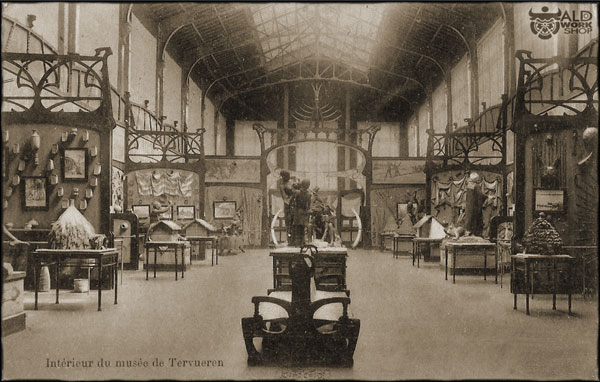
The Royal Museum for Central Africa — a museum with a worldwide reputation in the fields of natural history and anthropology — was a product of the 1897 Colonial Exhibition in Tervuren. There, the 'Palais des Colonies' was purpose-built for the occasion to showcase and promote commercial and public interest for King Leopold II's Congo Free State. Following its great success, as well as arousing wide scientific interest, the temporary exhibition was transformed into a permanent cultural and scientific institution, ‘Musée du Congo’, which opened to the public in 1898.
To accommodate the museum's rapidly growing collection a new neoclassical palace-style building was designed by French architect Charles Girauld. Its construction began in 1906 and was inaugurated as the new ‘Musée du Congo Belge’ in 1910 by King Albert I, renamed ‘Musée Royal du Congo Belge’ in 1952, and finally, when Congo gained Independence in 1960 it became ‘Musée Royal de l'Afrique Centrale’.

Musée du Congo in pictures

Palais des Colonies became Musée du Congo, and a permanent exhibition was installed in 1898.
The building was designed by the Belgian architect Albert-Philippe Aldophe and the classical gardens by French landscape architect Elie Lainé.
Architects associated with the Art Nouveau movement contributed to the interior design of the Palais des Colonies, such as Paul Hankar, Henry van de Velde, Gustave Serrurier-Bovy, and Georges Hobé.
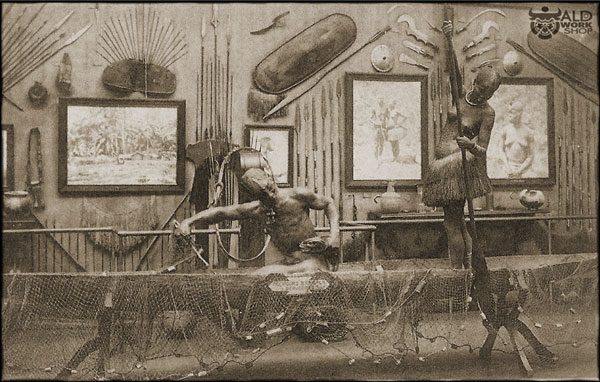
The ‘ethnographic’ sections were grouped in six compartments, separated by Art Nouveau partitions designed by Hankar, incorporating sixteen friezes decorated with paintings of ‘indigenous scenes’ by Adolphe Crespin and Edouard Duyck. The exhibits included eight groups of life-size figures representing Congolese ethnic groups by Isidore De Rudder, Julien Dillens, and Charles Samuel. Consisting of twenty-one polychrome sculptures adorned with authentic items of dress and accessories to enhance their realism.
Musée du Congo : Ethnographic room, 1898.
Musée du Congo : Natural History collection, 1898.
Musée du Congo : Fluid-preserved specimens of reptiles and fish, before 1910.
Musée du Congo : Ethnographic room, 1898.
Musée du Congo : Vuakusu-Batetela defending a woman against an Arab by Charles Samuel, 1897.
Musée du Congo : Native carriers by Julien Dillens, 1897.
Musée du Congo : A Teke chief of the Cristal Mountains by Julien Dillens, 1897.
Musée du Congo : Bangala fishermen by Isidore De Rudder, 1897.
Musée du Congo : Sango dancers by Julien Dillens, 1897.
Musée du Congo : Azande musicians by Charles Samuel, 1897.
Musée du Congo : Mayombe family scene by Isidore De Rudder, 1897.
Musée du Congo : Zappo zap blacksmiths by Isidore De Rudder, 1897.

Five interior scenes by Alexandre (Albert-Edouard Drains)
@ wellcome images uk


Colonial Guide 1897

The Official Guide of the 1897 Colonial Exposition held in Tervuren : Guide de la section de l'Etat indépendant du Congo à l'Exposition de Bruxelles - Tervueren en 1897 - Theodore Masui.
    References
  • Theodore Masui, Guide de la section de l'Etat indépendant du Congo à l'Exposition de Bruxelles - Tervueren en 1897, Bruxelles : Impr. Veuve Monnom, 1897.
  • Maarten Couttenier, Congo tentoongesteld: een geschiedenis van de Belgische antropologie en het museum van Tervuren (1882-1925), Leuven : Acco/KMMA, 2005.

A Voice From The Congo

The Chief of the Tribe, 1908. Royal Museum for Central Africa.

The Chief of the Tribe

A native of the African Congo seated on a lion skin and reclining against a wood tip stool on the back of which are suspended human skulls, attesting to his prowess in battle and symbolizing his office as chieftain. This over life-size sculpture symbolizes the “unknown world of primitives, with its mysteries, its savagery, its sufferings, and its promise.” [Heilig] It is a work to attract and hold the attention of the thoughtful visitor.
The Chief of the Tribe
Awarded the gold medal of the Société des Artistes Français in 1908.
This work was created by Herbert Ward (1863–1919), an English adventurer, writer, illustrator and artist-sculptor who was a nephew of the taxidermist Rowland Ward.

Herbert Ward

Born in London on the 11th of January 1863. He was the son of Edwin Ward, also a noted taxidermist and the elder brother of Rowland Ward (1847-1912). Edwin and Rowland were both trained in their father’s taxidermy studio before setting up their own and the former is the presumed author of 'Knapsack Manual for Sportsman on the Field', London, 1872 which is a guide to big game hunting around the world. For a while Edwin, his brother Rowland and their father Henry were all operating taxidermy businesses in London at the same time, causing a degree of confusion. Herbert's grandfather, Henry Ward (1812-1878), assisted John James Audubon in 1831 and went with him on the first collecting trip in America.
Herbert Ward evidently inherited his artistic talent and a visions of a wider world of adventure. He spent much of his early life travelling in New Zealand, Australia, Borneo, and the Congo.
When in Africa, from 1884-1889, Ward lived for five years among the native people, observing with great interest and sympathy their material culture and mode of life. He took notes and made drawings which were to serve him later when he pursued a career as an artist. He collected some 2700 specimens of their weapons and other objects of their material culture. Including zoological specimens, consisting primarily of hunting trophies such as an elephant head, a python, antelopes and a gorilla skeletons.
Herbert Ward's Paris studio displaying a collection of African Congo weapons, including bronze statue of The Chief of the Tribe, tusks and stuffed monkey. 1910
Photo: Harry C. Ellis, National Anthropological Archives, Smithsonian Institution.
Herbert Ward's Paris studio displaying African weapons and artifacts. An elephant trophy, a python, bronze statuary, and gorilla skeleton. 1910
Photo: Harry C. Ellis, National Anthropological Archives, Smithsonian Institution.
Once back in Europe he produced numerous sculptures depicting various peoples of Africa. Ward states his artistic goal was “to make something symbolical — not an absolutely realistic thing like wax works in an anatomical museum — but to make something which demands two different requirements; the thing must have the spirit of Africa in its broad sense, and at the same time it should fill the requirements of the art of sculpture.” It is this approach which distinguish his sculptures from scientific documentation, and other ethnographic sculptures and life cast studies.
Sterling Heilig, a Paris-based correspondent and Ward’s friend, says of the sculptures:
“The sculptor has infused into the dead bronze the pathos, the dignity, and the genius of the African forest dweller. He has brought home to us the infinite tragedy of the Congo in these marvelous reproductions of Central African types, which will tell all who see them of that unknown world of primitives, with its mysteries, its savagery, its sufferings, and its promise. Nothing but sheer power could have forced upon western cultured superficiality the interest which Ward's work excites — interest in a race long persecuted with pitiless cruelty, a race of another color, remote, incomprehensible to the western mind.”
Herbert Ward working on the Fire Maker in his studio in Paris.
Photo: The Outlook.
After Ward’s death, his collection of African ethnologica, together with his sculptures were donated to the Smithsonian Institution in Washington by his widow, Sarita Sanford Ward. Four large scale polychromed plaster casts versions of the sculptures entitled A Congo Artist, The Fire Maker, The Idol Maker, and The Chief of the Tribe are in the collection of the Royal Museum for Central Africa, Tervuren.

The Royal Museum for Central Africa

The Idol Maker - The Royal Museum for Central Africa.
The Fire Maker - The Royal Museum for Central Africa.
A Congo Artist - The Royal Museum for Central Africa.

A Biographical Note

A biographical introduction of Herbert Ward by Sydney S. Pawling [Mr. Poilu: notes and sketches with the fighting French. 1916]
... Ward sailed in an emigrant ship, the James Wishart, a 700 ton barque, for Auckland, New Zealand, a tougher discipline than even the uncongenial school life. For the three following years he graduated in a university of struggle and hardship in various parts of New Zealand and Australia, being in turn sailor, kauri-gum digger, coal and gold miner, sailmaker, gymnast in a travelling circus, and stock-rider.
Wishing to return to England, and not having any more attractive opportunity, he shipped as an A.B. before the mast in the full-rigged ship The Star of the Sea from Sydney to San Francisco, and round Cape Horn to London. The call of the sea was irresistible, and after a short stay he made two further voyages, one to New York in The Persian Monarch, a ship carrying Scandinavian emigrants, and again to Singapore. This last voyage was with the definite object of seeking adventure and experience in Borneo, where, through the interest of the Governor of the North Borneo Company, he was enrolled as a cadet in the service. This gave him the wider scope for which his abilities were fitted. He was sent on an important expedition of some hundreds of miles up the Kinabatangan River to an outpost at Penungah, among picturesque but uncertain natives. Here, for eight months, by tact and a sympathetic understanding with the natives, he did valuable work, until a severe attack of jungle fever laid him low.
After a few months of convalescence in England, in the autumn of 1884 Ward went to the Congo under the auspices of Sir Henry M. Stanley. Here he was commissioned to assist in the organisation of transport service, going far into the interior to found stations and persuade the various chiefs to lend their able-bodied men as carriers. Varied active service in what is now the Congo Free State lasted for two and a half years, when the news reached him of Stanley's arrival in command of the Expedition to relieve Emin Pasha in the Sudan. On his own initiative Herbert Ward collected a force of over four hundred natives as carriers, and marched down country with them to meet Stanley, placing his and their services at the great explorer's disposal. His offer was accepted, and he was enrolled as an officer (voluntary) of the Expedition, and a further two and a half years of unceasing and exciting work were passed in the centre of the Dark Continent.
In 1890 Herbert Ward married, in America, Sarita, daughter of C. H. Sanford of New York, and settled for ten years in England. His interest and work in sculpture called him, in 1900, to Paris, and there he migrated with his family of five children, alternating between the busy studio and home life of the city, and a beautiful country home at Rolleboise on the Seine, forty miles from Paris.
The years between 1900 and the outbreak of the present war were full of fine work in sculpture, mainly concerned with the presentation of the Central African life he has always loved so well. A constant exhibitor at the Salon, where he was awarded two gold medals, he was further honoured by specimens of his work being acquired for the Luxembourg, and in 1911 he received the Cross of the Legion of Honour. ...

Explorations and adventures in Borneo

"Good-bye till we meet again in London."
Drawn by W.H. Margetson, from a sketch by Herbert Ward.
After a brief rest in England Herbert Ward started for North Borneo as a cadet in the service of the British North Borneo Company. In the awful jungles and malarial swamps which constitute a portion of that domain he contracted worse fevers than he ever afterwards experienced in Africa, and he was compelled to return to England.
He brought back with him but one happy, yet painful, reminiscence from the Bornean forests — namely, the friendship he had formed for Frank Hatton, an attractive, bright, accomplished young fellow, who seemed destined to do exceptionally good work in the service of the North Borneo Company, but who, by a most regrettable accident, was killed by the chance discharge of his gun when forcing his way through a jungle.
Ward, having been the first and nearest white man to learn the news and particulars of Frank Hatton's death, was able to supply the relatives of the deceased with a fuller account of what had occurred than the meagre telegrams which had been transmitted by the authorities, and in this way he became acquainted with his companion's father, Mr. Joseph Hatton, who eventually introduced Ward to Stanley , and thus got him an appointment in the service of the Congo Free State in 1884.
[The Speaker, vol.2, 1890.]
Frank Hatton (31 August 1861 - 1 March 1883) was a British geologist and explorer. His father, the journalist Joseph Hatton (1839–1907) wrote a biographical preface to the book on North Borneo published posthumously based on field notes. Herbert Ward is mentioned in the last diary from the expedition: 'North Borneo: explorations and adventures on the equator', 1885.

Published works by Herbert Ward

Ward published several volumes of reminiscences: 'Five years with the Congo cannibals', Chatto & Windus, 1891; 'My Life with Stanley's Rear-Guard', CL Webster, 1891; 'The Voice from the Congo', Scribner & Sons, 1910 and 'Mr. Poilu: Notes and Sketches with the Fighting French', Hodder & Stoughton, London, 1916.

Herbert Ward's Gift to the National Museum

The Herbert Ward African Collection on display in the United States National Museum, 1921.
Smithsonian Institution Archives.
The museum’s first permanent exhibit was on view from the end of the 19th century until the 1960’s. In 1922 it was modified when a new exhibit was installed which featured the Herbert Ward collection. As Mary-Jo Arnoldi points out, ”the curators consciously worked to captured some of the drama that Herbert Ward had achieved in his private set up of his collection in Paris. This new installation represented a shift in style of ethnology exhibits, but not in their interpretative intent. The exhibition articulated and reflected the principal late-nineteenth century beliefs and attitudes about Africa and Africans, and it contributes publicly and dramatically to supporting an already popular discourse of misunderstanding about the continent and its peoples.”
'The Cultures of Africa', the museum's second permanent exhibit opened in the late 1960’s. The Ward sculptures had no place in this new narrative, and most of them were removed. "The dismantling of the 1922 installation, the integration of the Ward collection of African material culture with other collections, and the displacement of the Ward bronzes has effectively eradicated the intimate association between the collection and the collector that once was so much a part of the collection’s history." [Mary-Jo Arnoldi] The new exhibit remained on view with few modifications for quarter of century until it was dismantled in 1992 amid public controversy.
Mary Jo Arnoldi's article entitled 'From the Diorama to the Dialogic : A Century of Exhibiting Africa at the Smithsonian's Museum of Natural History' gives a brief history of the African anthropological collections at the Smithsonian. It analyses the history of permanent African exhibits and the relationship to specific anthropological theories.
The former U.S. president and African big game hunter Theodore Roosevelt, who visited the artist's studio in Paris, wrote a brief article entitled 'Herbert Ward's Gift to the Smithsonian' on the life work of Ward.
Reviews on Herbert Ward's bronzes by Elbert Francis Baldwin, 'Herbert Ward: Explorer, Sculptor, War Worker' ; Jay Culver, 'Herbert Ward - An Artists and Adventurer' ; Leila Mechlin 'The Herbert Ward African Collection' ; The Independent, 'The Soul of the Black'.
    References
  • Department of Anthropology photograph collection of anthropological exhibits 1890-1910, Smithsonian Institution
  • Pat Morris, Rowland Ward Taxidermist to the World, MPM 2003.
  • Baldwin, Elbert Francis, Herbert Ward: Explorer, Sculptor, War Worker, New Outlook, v.30, 1922.
  • Mechlin, Leila, The Herbert Ward African Collection, Magazine of Art, v.13, 1922.
  • Culver, Jay D., Herbert Ward - An Artists and Adventurer, Dearborn Independent, Volume 22, 1922.
  • The Soul of the Black, The Independent, v.74, May 1, 1913.
  • Holmes, William H., Herbert Ward's Achievements in the Field of Art, Art and Archeology, Vol.18, 1934.
  • Arnoldi, Mary Jo, A distorted mirror: the exhibition of the Herbert Ward Collection of Africana, Chater 14, In: Museums and communities: the politics of public culture I edited by Ivan Karp, Christine Mullen Kreamer and Steven D. Lavine.
  • The Speaker, vol.2, 1890.
  • Rowland Ward, A Naturalist's Life Study in the Art of Taxidermy, London: Rowland Ward, 1913.
  • Wikipedia, Herbert Ward